

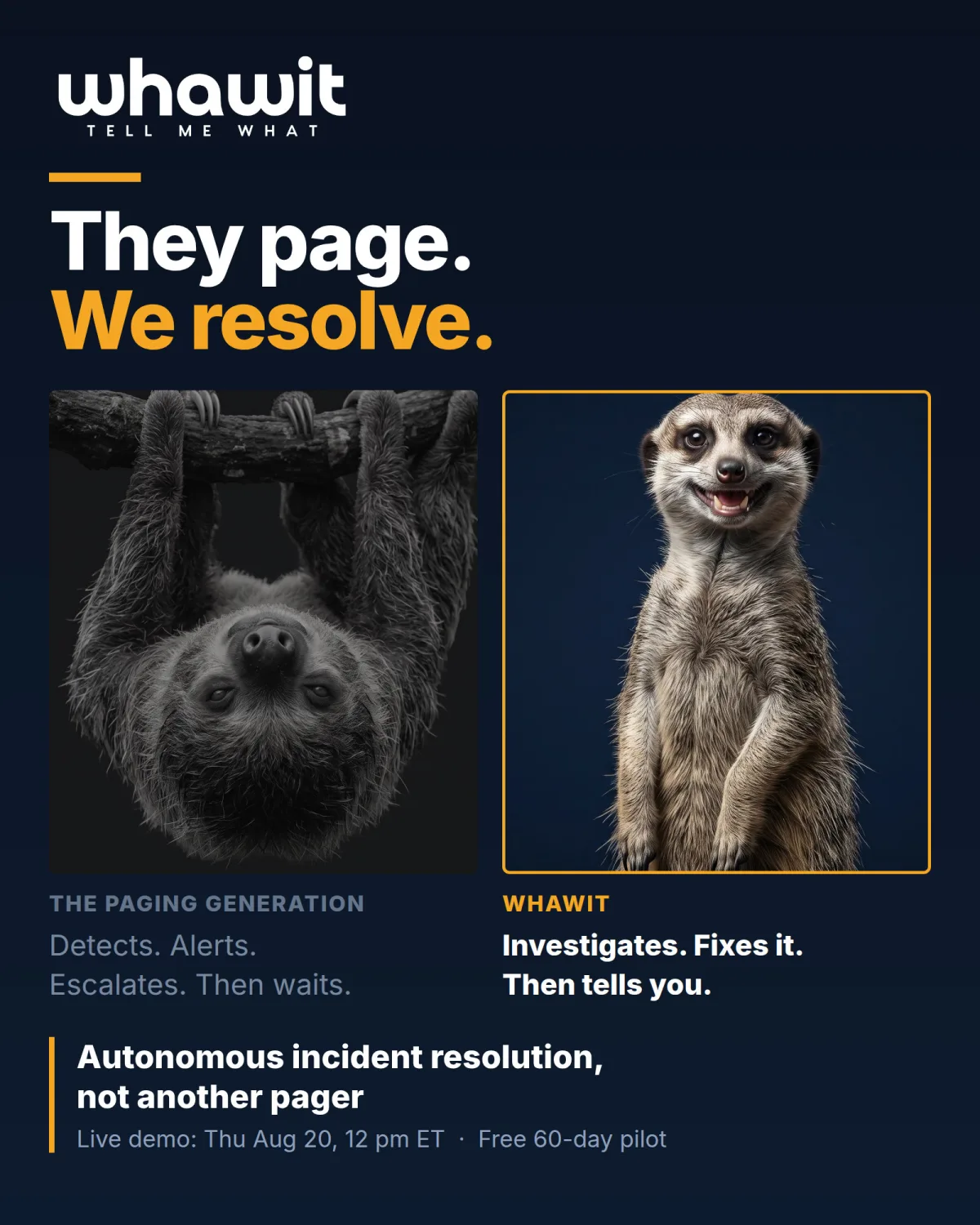
They page.
We resolve.
Detect. Alert. Escalate. Then hang there and wait for a human to do the actual work. That is PagerDuty, that is Opsgenie in whatever time it has left, that is incident.io, Rootly and JSM. Fifteen years spent making the alarm ring faster, and not one minute spent on what happens after it rings.
Come watch the other half. Thirty minutes of live incident, ten minutes of questions, no slides.
Next session
Hosted by Jose Escrich, who runs every pilot personally.
No live session is scheduled right now. A 1:1 walkthrough covers the same ground against your own stack.
What you will actually see
- 1
An alert fires, for real
From a connected provider — Datadog, CloudWatch, Sentry, GCP — not a mock payload on a slide.
- 2
WHAWIT goes down the hole
Recent deploys, logs, metric anomalies and traces across the stack, answering the 3 AM question first: did anyone touch anything?
- 3
It resolves what it can resolve
Then reports what it did, with the evidence attached. Paging a human is the fallback, not the product.
- 4
Q&A and pilot slots
Ten minutes of questions, and how the free 60-day pilot works against your own stack.
Who it is for
- SRE, platform and DevOps leads picking an Opsgenie replacement
- Engineering executives who own MTTR and the on-call budget
- Teams already on PagerDuty, incident.io, Rootly or JSM asking what comes after the alert
One honest limitation
WHAWIT can only investigate what it can reach. No read access to the system that broke means you get an evidenced hypothesis instead of a fix. Still beats fifteen tabs.
Migrating off Opsgenie
Atlassian stopped selling Opsgenie in June 2025 and support ends on 5 April 2027. If you are picking a replacement right now, the session is the short version of that decision.
WHAWIT vs Opsgenie, feature by featureCan't make a live session?
Book a 1:1 walkthrough instead. Same demo, run against your stack, with the free 60-day pilot on the table at the end.